“Of all man’s instruments, the most astonishing, no doubt, is the book.”
— Jorge Luis Borges
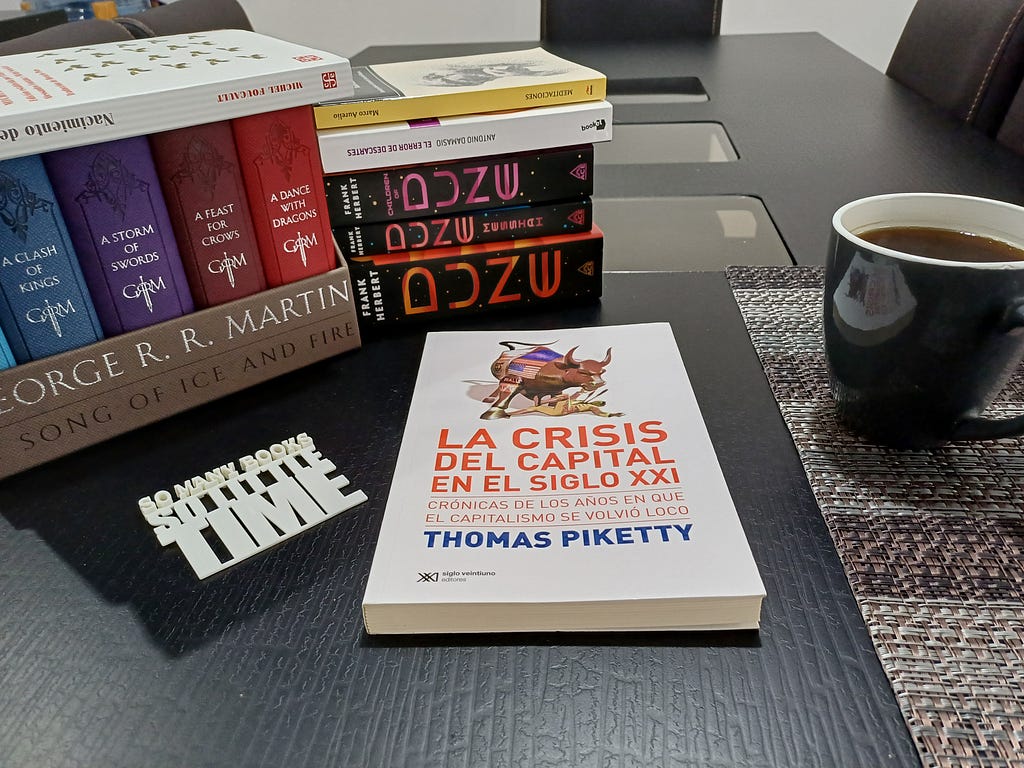
What will you do tomorrow? And next weekend? Do you have a goal for this year?
By answering these questions, anyone else would begin to know you, because in the course of a natural conversation your work, your hobbies and some of your motivations would inevitably come up.
But what if, instead of someone else, it were you who asked, with all the sincerity the case demands: Why will you do that tomorrow? When did you decide that would be the plan? What would happen if you didn’t do it?
As we go deeper into each question and change the time scale, from tomorrow’s plans to the weekend and even the next ten years, interesting things can happen. We will inevitably dwell on our wishes and longings, the things we want and hope will fill us with joy. There will also be anxiety and stress, over some important event that may or may not arrive and will force us to make a decision. Perhaps, in the middle of this conversation with ourselves, the idea of having a purpose will emerge, whether we are lucky enough to have set or found one some time ago, whether we are weighing one, or whether it simply hasn’t been necessary to consider it until now. Whatever the scenario, while these questions are argued inside us, our own voice will echo in that most abstract of dimensions we call consciousness.
Meanwhile, in the real world, tomorrow it will be normal to start another day by turning off the alarm and carrying on with a routine, well or badly planned, doing what we believe we should be doing, and never once thinking about why we do it. After all, this so-called real world comes with so many debts, obligations, problems, plans and goals: what is the point of sitting down for five minutes to think about abstract things?
Our two dimensions, who we are in our consciousness and who we are in the material world, collide in one simple concept: decisions. What are we, then, if not the sum of all the decisions we have been able to make so far? Each of them is no more than a mere action, something that passes from our mind to our brain and so becomes material.
The brain is an exceptional organ; suffice it to say there are far more neural connections in our skull than stars in the Milky Way. We know clearly that it works through an unimaginable number of electrical impulses and chemical reactions, that it is closely tied to our digestive system and caught in a cycle of mutual influence with our senses. But what we have no idea of is when or where the brain ends and the mind begins. At what moment do electrical impulses become our childhood memories? At what point do neurotransmitters turn into a broken heart? Is our consciousness only the result of all the quantum interactions of every atom in our head? What, in itself, is life?
Questions we will surely never answer, but which are not needed for them to make our existence on the face of the earth fascinating, nor are they a barrier to the connection of all humanity across time, something we call language and knowledge. That mechanism which lets humanity advance, gradually, generation after generation, in its understanding of reality. How different history would be without Newton’s Principia Mathematica, Kant’s Critique of Pure Reason or Einstein’s General Relativity.
If knowledge can shape all of humanity, why couldn’t it shape our individual lives? We could use that knowledge to enrich our minds and prepare them to make decisions that improve our material reality. We could start from the legacy of Santiago Ramón y Cajal to understand how to care for our brain and its relationship with our body, and even relate it to Carl Jung’s theory of personality to help us understand ourselves. With Fyodor Dostoevsky and Michel Foucault we could understand why today’s structures of power are so dangerous to our own existence, and why as individuals we should not be more important than society. With Seneca, Epictetus and Marcus Aurelius we could come to terms with the idea of inherent human suffering. We could seek a caress for the soul in the beautiful writing of Jorge Luis Borges, or marvel at the knowledge of the universe of Kip Thorne and Stephen Hawking, or both at once by reading Edgar Allan Poe’s Eureka.
Books can shape the mind of a stubborn programmer: make them more empathetic, pull them out of the fallacy of meritocracy and reconcile them with their introversion, make them strong and responsible for their decisions, show them the path of discipline and the courage needed to pursue their dreams. And above all, teach them in which book, specifically, to check that those dreams are indeed the right ones.
So there is only one last question left:
If on some shelf or in some box, somewhere in the world, within some cover of cardboard, paper or perhaps leather, on who knows what page, someone you will surely never meet wrote something that could change your life, what would you do to find that paragraph?